How to Save for a House Down Payment Without Guessing at the Goal
how to save for a house down payment with a target, timeline, and paycheck plan. Separate the down payment from closing costs and cash you need to keep.
By Ultimate Budget Planner by Cosmo Suite · Editorial policy
Published · 9 min read
General information, not financial advice.
A house fund can feel stuck when the target keeps moving. You may be mixing the down payment with closing costs, moving expenses, and money you would rather keep for an emergency. A usable target needs to show each cash need separately.
Start with a working target, split it into separate jobs, and set a monthly amount that fits your paydays. The figures below are examples for planning arithmetic. A lender or HUD-certified housing counselor can help you check the costs and programs that apply to your situation. A budget workbook for lining up savings and bills can keep those monthly figures in view.
Key Takeaways
- Keep the down payment, closing costs, moving expenses, and emergency savings in separate lines.
- Divide the amount still needed by the months in your timeline, then see whether that monthly amount fits your actual paydays.
- Treat early estimates as editable. A lender can help refine loan costs and a HUD-certified counselor can help you review options.
A down payment is one part of the cash you need
The down payment is the part of the home price you pay upfront. Your total cash need can also include closing costs and expenses just after moving in, while other savings and an emergency cushion still have to cover their own jobs. Keep those amounts in separate lines.
The Consumer Financial Protection Bureau (CFPB) says closing costs are separate and vary with the home price, location, lender, and loan. Its down payment guide gives an early estimate of 2% to 5% of the purchase price, but a lender can give you a more specific estimate as you shop. The CFPB also advises setting aside money for other savings goals, moving costs, possible renovations, and an emergency cushion before working out how much cash is available for closing.
Choose a home-price range to explore, estimate each cash need, decide which savings stay untouched, and calculate the amount left to save. The estimate can change when you learn more, so use it as a starting point until you have better figures.
Cash available for closing is the money left after you subtract other savings goals, moving or renovation costs, and an emergency cushion from available funds. The CFPB uses this kind of subtraction before estimating a maximum down payment. For a household budget, keep the calculation in two parts: total the cash needs for the home, then subtract savings already assigned to those same needs. Keep the emergency cushion outside that home total so it cannot be counted twice.
For a wider view of how cash lands against bills, see this budget spreadsheet guide for matching a budget to paydays. A savings target gets easier to review when it sits beside the month’s actual bills.
House down payment savings: The Decision Table
Use the line that describes where you are now. The amounts are not a required mortgage plan. They show how to turn a chosen target into a number you can check against your own budget.
| Starting point | First calculation | What to keep separate |
|---|---|---|
| You have a home price range | Estimate down payment and closing costs | Moving, repairs, other goals, emergency cash |
| You have a total cash target | Subtract money already assigned to the goal | Money already reserved for other needs |
| You have a savings balance | Decide what portion is available for the home | Any cushion or other goal you are keeping |
| You have a deadline | Divide the remaining target by months available | The monthly amount your paychecks can support |
Use the total-cash line only after you have checked the moving and early-home costs. Otherwise, the same savings can appear to cover both closing and the first repair. A simple goal table can make those assignments visible.

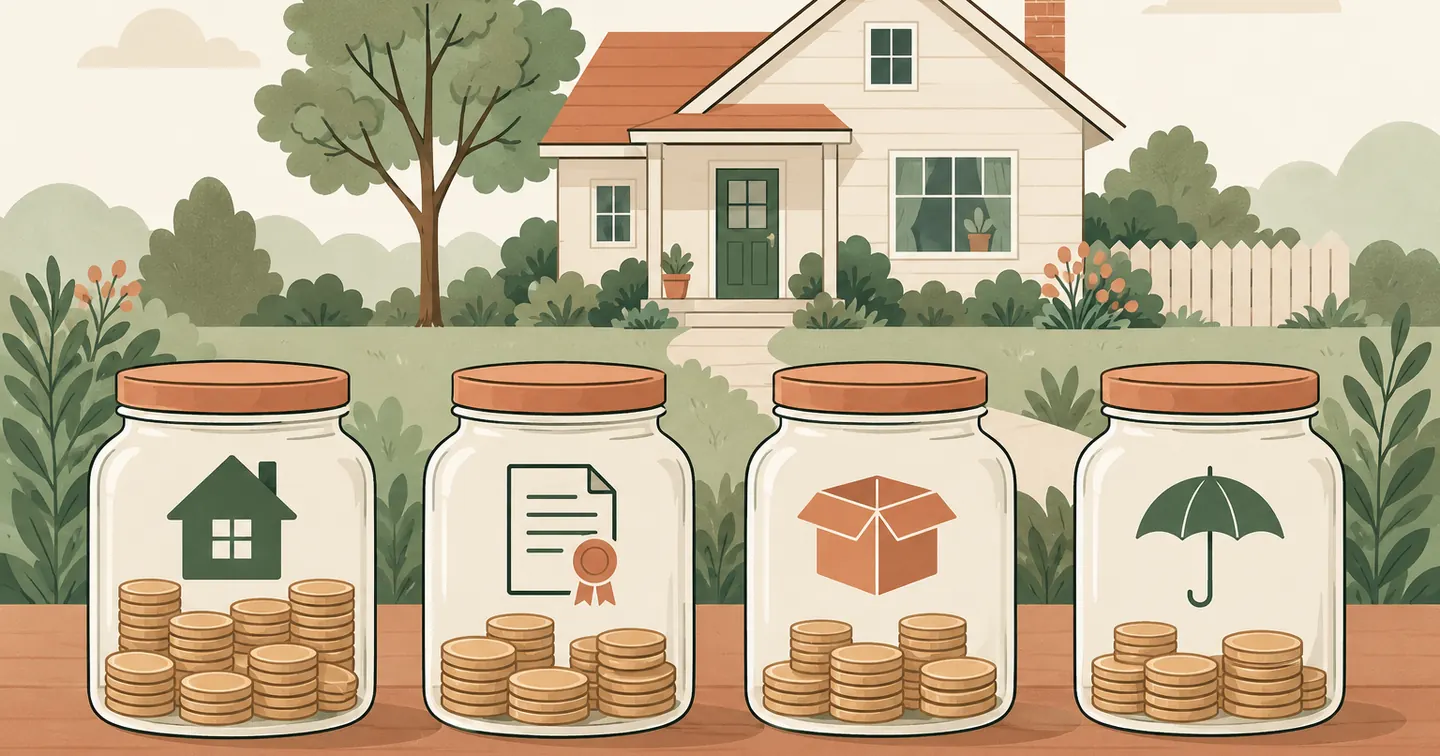
The four lines in this illustration give each part of the plan its own place. It is a planning layout, not a lender worksheet or an estimate of what a specific purchase will cost.
The Worked Month: Turn a target into paycheck amounts
Suppose your illustrative savings target is $30,000, you have already set aside $6,000 for that goal, and you want to reach it in four years. The remaining amount is $24,000. Dividing $24,000 by 48 months gives a planned contribution of $500 a month, before any interest.
If you are paid biweekly, each month may have a different number of paychecks. A two-paycheck month with $1,950 take-home pay brings in $3,900. You could assign $250 from each check toward the $500 monthly target, then use a three-paycheck month to catch up, cover another goal, or leave the extra in the checking buffer. Treat the $500 as arithmetic for this example, not as a recommended savings amount. The point is to place the planned amount against the cash that arrives.
| Money in | Money out | Left for the goal |
|---|---|---|
| Two take-home checks: $3,900 | Planned home-fund deposits: $500 | $3,400 before other bills and spending |
The $3,400 still has to cover rent, utilities, groceries, transportation, and other bills. If $500 leaves too little room, adjust the target or the date and check the arithmetic again. Treat the timeline as a planning estimate and update it when the month changes.
If you use a paycheck budget, put the deposit on the check that can carry it. If the first check covers rent and utilities, the second may be the more realistic place for part of the transfer. This is the same timing question covered in how to plan rent against your take-home pay.
Build the monthly amount around your paydays
Once you have a remaining target and a date, choose a deposit pattern that matches how you receive income. A monthly target is easy to compare across months, but it may not match the dates when your money arrives. If a deposit would leave a bill short, the plan needs different timing.
For a monthly paycheck, you might set one transfer after the deposit clears. With biweekly pay, you can split the amount across two checks in most months and decide what to do when a third check arrives. With irregular income, start with the lower amount you can count on, then review extra deposits after they arrive. These are budgeting options, not mortgage rules.
Write down the expected transfer date beside the amount. If the deposit depends on a certain paycheck, assign it there. If several bills compete for that check, put the bills and savings line in due-date order. That makes the tradeoff visible before the transfer happens.
You can use this quick calculation again whenever the plan changes:
- Choose a working cash target and list what it includes.
- Subtract what is already set aside for that same goal.
- Divide the remainder by the number of months available.
- Compare that amount with the paychecks and bills in a typical month.
If the amount misses your budget, try a later date or revise the working target with a lender's estimate. Match the plan to actual deposit dates because monthly averages can hide the cash available in a specific month. A budget plan based on your real paydays can help you keep those dates beside the savings line.
Set a target you can revise
Begin with a range rather than a precise home price. Then write down the assumptions behind the first estimate: likely price range, down payment amount to explore, closing-cost estimate, and separate moving or early repair cash. The CFPB notes that early figures are rough and should be refined as you move through the process.
Do not assume that 20% is the only possible down payment. The amount depends on the loan and lender. Some programs allow lower amounts, and some may have no down payment requirement for eligible borrowers. Lower down-payment options can come with higher costs, so compare the full loan terms with lenders. The CFPB's answers about down payment choices explain the tradeoffs. The CFPB home-buying guide says to account for costs beyond the down payment, such as closing, moving, repairs, and ongoing ownership expenses.
Keep the target editable. If the price range changes, revise the estimate. If your timeline changes, update the monthly amount. If a lender's estimate changes the closing line, update that line without quietly subtracting from your emergency cushion.
When you compare loan options, ask what cash is needed at closing and what costs could arrive immediately afterward. The CFPB says costs vary by home, location, lender, and loan type, so a general web estimate cannot replace a lender's figures. If you are still deciding what to include, a HUD-certified housing counselor can help you understand local programs and the tradeoffs in the options available to you.
Give every savings dollar one job
Use separate rows for the down payment, closing costs, moving, early repairs or setup, and other savings you want to protect. A row is enough; each amount does not need a separate bank account. The purpose is to avoid counting one dollar twice.
The CFPB's home-buying preparation guide lists costs beyond the down payment, including insurance, taxes, closing costs, moving costs, repairs, and utilities. Those expenses can affect the cash you want available after purchase. Your own list will depend on the home and location.
Keep notes beside estimates: “rough closing range,” “ask lender,” or “moving quote pending.” A note shows which line needs a better number. It also keeps a rough guess from looking like a confirmed bill when you review the plan later.
What moves the goal without hiding the tradeoff
Change one input at a time. If the monthly amount feels too high, first test a later date or a different home-price range. Keeping the other numbers fixed helps you see what changed.
Use planned money carefully. A bonus or tax refund can shorten the timeline if it arrives, but do not make the monthly plan depend on money that is uncertain. Enter it after it reaches your account, then update the remaining amount.
Review recurring costs at renewal. A bill that changes once a year can affect the amount available for a home fund. The lifestyle inflation check shows a way to compare recurring costs with a new monthly amount.
Keep the cushion visible. The CFPB advises subtracting an emergency cushion and other savings goals before deciding how much is available to close. A home target should not quietly consume money you had assigned elsewhere.
Make the next action small. Choose an amount for the next paycheck, record it, then compare the balance with the target at month-end. If the deposit did not happen, revise the plan instead of copying the same number forward without checking.
If you want those amounts beside the rest of your monthly budget, the Ultimate Budget Planner workbook includes Excel and Google Sheets versions with paycheck and monthly views.
Why Trust This Article
Cosmo Suite makes the Ultimate Budget Planner. The examples here are illustrative arithmetic, not mortgage estimates or a recommendation about how much to save. We checked the CFPB’s home-buying and down-payment guidance on October 26, 2026. Our editorial policy explains how we handle sources and corrections. Your lender and a HUD-certified housing counselor can help verify costs and available programs for your situation.
Where the Ultimate Budget Planner Fits
The home-fund amount is only one line in a household budget. The rest of the month still has to cover bills and spending, and the timing matters when paychecks arrive every other week. A budget spreadsheet for Excel and Google Sheets gives you a place to view the savings line beside those monthly amounts.
The Ultimate Budget Planner includes 28 tabs across four sections, Excel and Google Sheets files, auto-fill tabs, automated dashboards, and reusable yearly tabs with no subscription. Its paycheck view can help you see which check is expected to cover a planned deposit. The file does not estimate mortgage costs or choose a savings target for you.
When you review the monthly budget, keep your lender estimates and other savings needs in view as you decide what amount belongs in the home fund.
Frequently asked questions
How do I start saving for a house down payment?
Start with a home price range you are considering, then estimate the down payment and separate cash for closing and early home costs. Check the numbers with a lender or housing counselor. Subtract money you already plan to use and divide the rest by the months you have.
How much should I save for a down payment?
It depends on the home, loan type, lender, and your other savings needs. Some loans allow lower down payments, while a larger one can change loan costs. Set a working target, then ask lenders about the total cash needed to close.
Should I save for closing costs separately?
Yes. Closing costs are separate from the down payment, and their amount depends on the home, location, lender, and loan. Keep the estimate as its own line so the down payment goal does not spend the same dollars twice.
Can I save for a down payment and keep an emergency cushion?
Yes. Treat the cushion as money with a different job from the home fund. The CFPB recommends accounting for an emergency cushion and other savings goals before deciding how much cash is available for closing.
How long does it take to save for a house down payment?
Divide the amount still needed by the number of months in your timeline. For example, a $24,000 gap over 48 months means $500 per month before any interest. Change either input when your budget or timeline changes.
What is the fastest way to save for a down payment?
A faster timeline requires a larger amount saved each month, a smaller target, or both. Review recurring costs and planned one-time money, but keep other bills and savings goals visible before changing the monthly amount.
